
DDNJ Author Insights Episode 22: Protection and Advocacy Agencies
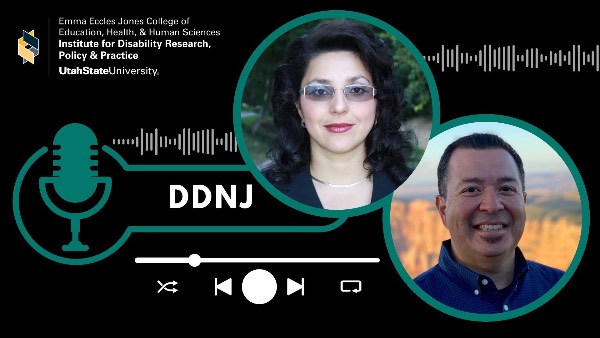
Adina Zahradnikova and JJ Rico lead different protection and advocacy organizations, but they share some similarities. Both have personal connections to people with disabilities. Both started in protection and advocacy work shortly after law school, in 2001. Both approach their jobs with passion and dedication to protecting the rights of people with disabilities.
They sat down with IDRPP Executive Director Matthew Wappett for an interview with the Developmental Disabilities Network Journal Author Insights Podcast.
Every state and territory has a protection and advocacy (P&A) agency; another pillar of the nation’s developmental disabilities network. The P&A agencies vary from state to state, but their scope is typically broader than that of the University Centers for Excellence in Developmental Disabilities, or UCEDDs. (IDRPP is the UCEDD for Utah.) Both the Disability Law Center, led by Zahradnikova in Utah, and Disability Rights Arizona, led by Rico, focus on fair housing in addition to giving people with disabilities access to their communities and their civil rights, including voting.
“What makes P&A systems unique and important is their special legal authority that … allows us to visit facilities and be where people with disabilities are in real time,” Zahradnikova said. “Because of this unique access authority, we can see what is really happening in real time, not just what's reported on paper.”
“As Spider-Man, I think, says, with great power comes great responsibility,” Rico said. “We most definitely make sure that we're using our access authority in the best way possible.”
“We have put a lot of resources, a lot of energy into making sure that individuals with disabilities are living in integrated settings,” Zahradnikova said. “We've achieved that through systemic legal work, a big class action lawsuit that we successfully settled that allowed 400 people to move out of institutional settings into the community. But we've also used other tools that we have at our disposal, such as public policy and training, and education to help our Utahns with disabilities live independent lives.”
P&A agencies have a real impact on society, Zahradnikova said. Without them, the ability to enter facilities and review records, investigate concerns and talk to people with disabilities in those settings would be lost. “If we disappeared, the impact would not be subtle. I think it would leave a major gap on in how people with developmental disabilities are supported and protected. There would be far less oversight.”
“I've worked in this space for 25 years,” Rico said. “I've seen the horrific living conditions, the abuse that's gone on. We still see it, right? … I don't know why we want to go backwards when there are so many advances we've made.
“When [people] think of abuse and neglect, they think of Willowbrook,” Zahradnikova said. “That happened 60 years ago. But I can tell you that there are so many facilities here in Utah that are not far from those conditions.”
“I have a 19-year-old son with a disability,” Rico said. “It’s not only a personal, but it's also a professional passion of mine to see my son living the work of our agency. He went through early intervention programs to special education, now going into vocational rehabilitation programs. Seeing the opportunities that he's gained have largely been created by P& A's. The thought that he'll never be in an institution because of the advocacy and work that the P& A system has done really motivates me, not only as a father, but as a leader in this organization. …
“I was involved in litigation against a local movie theater chain to ensure that captioning systems were provided, and also audio description systems were provided both for the deaf and also the folks who were blind,” Rico said. “It went all the way to the Ninth Circuit. So as a young attorney, getting to go to the Ninth Circuit to argue such an important case was really impressive. Scary. A lot of emotions. And to prevail and have a Ninth Circuit ruling to say that captioning and audio description are both auxiliary aids and services that movie theaters need to provide... is still one of the things that I'm most proud of.”
You can listen to the entire conversation on the DDNJ podcast or in the player embedded in this blog post.