
Guest Review: Out of My Mind
"There could have been many ways to sugarcoat this film,
but the filmmakers did not go that route.
It felt realistic to me," writes Barraclough, a reviewer with CP.
A film worth watching
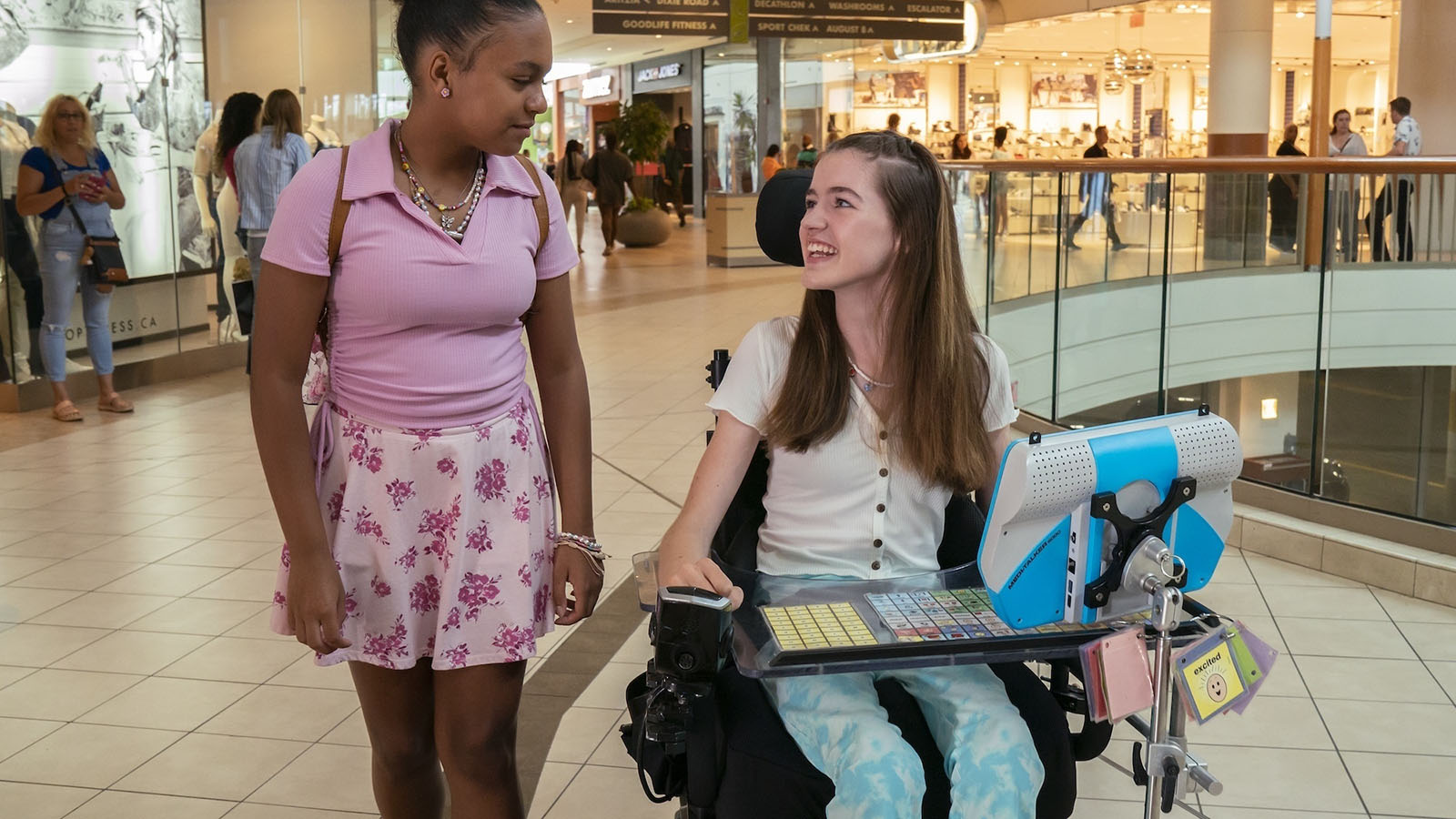
The protagonist of the 2024 film Out of My Mind is Melody Brooks, a 12-year-old girl with cerebral palsy (CP). She explains in a voiceover to begin the film that she can’t speak verbally because “my tongue won’t cooperate” but, “believe me, I have so much to say.” The film is about Melody finding and using her own voice and shows her navigating sixth grade.
Up until this point, she has gone to school with other special needs students and has had the same teacher every day since kindergarten. But, as part of an experimental program, she goes into a regular class one afternoon a week. She is very excited but faces the challenge of being accepted by the teacher and students.
The film Out of My Mind, based on a 2010 novel by Sharon M. Draper, was directed by Amber Sealey and written by Daniel Stiepleman. In her first-ever acting role, Phoebe-Rae Taylor, who has CP and uses a power chair, stars as Melody. In a fun twist, Taylor is a big fan of actress Jennifer Aniston, who voiced Melody’s inner thoughts in the film. As the film’s ending credits start to roll, Melody has an exchange with Jennifer Aniston in which she thanks her for letting her borrow her voice but says she will use her Augmentative and Alternative Communication (AAC) machine to speak from now on. Speaking for yourself is one of the film’s biggest themes.
When Melody is initially assessed for insurance to pay for her AAC machine, she’s asked, “Which one of these is not like the others” and her inner voice explains various differences among the five options, but the question is so generic that she’s not sure which answer they want. She chooses a “wrong” answer, while telling the audience the logic of her choice. Her low assessment score makes it look like she’s not intelligent when the audience knows she is. I remember a vision assessment with pictures of objects I had never seen in my life, like a rotary phone and a sloth.
What is inclusion? Full inclusion is inclusion of the mind and the heart, not just being able to get into the same room as everyone else. The film does an effective job at showing how full inclusion goes deeper than accessibility and gets to adjusting the assumptions and attitudes people have about disabilities. I saw inclusion and exclusion in both classrooms. An example from the special needs classroom is Melody alone at the window, listening to the audiobook Are You There God? It's Me, Margaret by Judy Blume, an age-appropriate novel. When a doctoral student asks her questions about the book, we see that Melody comprehends what she’s listening to and has opinions on it.
Out of My Mind is available to stream on Disney+. It is quite humorous as well as touching, and it will stay with you long after it’s over. It is a film about a girl finding her voice.
There could have been many ways to sugarcoat this film, but the filmmakers did not go that route. It felt realistic to me, especially because you cannot control the responses of others, but you can control how you think about yourself and what you choose to do. Melody finds her voice literally through her AAC machine and she starts to accept herself. Self-acceptance won’t solve all her problems, but it is a necessary first step. Her empowerment by the film’s conclusion has come from within, with encouragement from her parents and her neighbor. As her inner voice puts it, “Doesn't matter what I sound like. All that matters is what I have to say.”