
IDRPP’s Place in Disability Research, Policy & Practice

IDRPP Executive Director Matthew Wappett speaks at USU's Blue Plate Research event.
Executive Director Matthew Wappett Explains Where the Institute Fits in Disability History
Editor's note: The following is an excerpt from the Blue Plate Research Presentation in April. Matthew Wappett, Ph.D, spoke on disability history, the need for government involvement in disability services, and IDRPP's policy role. You can view the entire presentation on the USU Research YouTube Channel.
Approximately one in every four Utah adults has a disability. Of those disabilities, the most common are mental health issues.
One of the areas that we are really focused on at the Institute, is the mental health of people with disabilities. Although 30 percent of all adults have mental health issues, 60 percent of individuals with disabilities have co-occurring mental health issues. And a lot of that is due to the challenges and some of the things they face on a day-to-day basis that makes it hard.
So we talk about disability. Why do we have government programs for people with disabilities? Why isn't this the responsibility of families, churches, community organizations?”
Going all the way back to the Middle Ages, people with disabilities lived within the community. They lived with their families. They could inherit property. One of the other things that people with disabilities did during the Middle Ages was they begged. Begging was a career. You had guilds. You had trade unions of beggars. You were trained on how to be a beggar. And you would travel around from city to city begging.
Now, after the last wave of the Black Plague, through Europe, most of Europe passed poor laws. And all of a sudden, begging was criminalized. And people with disabilities were rounded up, and they were herded into prisons, hospitals, almshouses, workhouses, other poverty relief systems. And they became wards of the state, essentially.
Now, here in the United States, colonists brought that institutional system with them and set up institutions across the United States.
As we progressed up into the 20th century and through the 1960s and the Civil Rights movements, parents organized. And they decided that these institutional settings were not the best for their children. And in fact, the mortality rates in these institutions were horrible. Ninety percent of people in them had some communicable disease like hepatitis or tuberculosis. The lifespan of people living in institutions was about 36 years old.
And yet, we had 400 years of people [with disabilities], “disappeared.” We didn't have the skills or the systems or the understanding or the knowledge to really understand, how do we support these people within our nation.
So what is the role of families, churches, and community organizations then? Well, they still play an important role. They still do a lot of the services, and yet it's been really important that government be involved. The government is the only sort of entity that can ensure rights, can mobilize sufficient resources, regulate infrastructure, and ensure that the support that we provide people with disabilities is not merely charitable, but it's a matter of equal citizenship.
So going back to the 60s and 70s, let's talk about what a UCEDD is. The Institute for Disability Research Policy and Practice is what is called a University Center for Excellence in Developmental Disabilities (UCEDD).
UCEDDs were set up in the 1960s by the Kennedy administration. JFK's sister, Rosemary Kennedy, had a significant cognitive impairment. She had been institutionalized, and they moved her out because of the conditions.
And they developed a system called the Developmental Disabilities (DD) Network. It was signed into law under the DD Act. The goal was to strengthen US disability systems.
We are Utah's UCEDD, as defined by the Developmental Disabilities Act. We were founded in 1972 by Dr. Marvin Fifield. We started as a special education school. It was actually called the Exceptional Child Center when it started. It was recognized that it was going to be important to have an institute that was focused on training teachers and developing practices, systems that support students with disabilities. USU is a land grant institution, and the vast majority of our work is focused on community engagement. It's a perfect match for the land grant mission.
People at the Institute, including founder Marvin Fifield, chaired Senator Orrin Hatch's disability advisory committee for over 30 years. Orrin Hatch was one of the original sponsors of the Americans with Disabilities Act. The institute played a key role in helping Orrin Hatch draft the ADA before it was signed into law in 1990. We've been very much involved in shaping disability policy, not just in the state but nationally. In fact, researchers and professionals at the institute helped craft the language that's currently in the Individuals with Disabilities Education Act.
Our mission today has changed. We're not a school. We are a research institute. We cover a vast range of programs. We are working to create inclusive communities and improve lives for children and adults with disabilities through sustainable innovation, collaborative research, responsive service, and interdisciplinary training and education.
We are 90 percent grant funded. We receive about $641,000 from the Administration on Community Living and Federal Administration that sort of houses UCEDDs and DD councils. It comes through our core grant, and our responsibility is to leverage that funding to bring in additional grants and contracts to the university.
Last year, we leveraged $52.75 for every $1 of federal money we received. We like to think that's a good return on investment.
We've become one of the largest research centers in disability in the nation and the state of Utah. So in FY25, just in terms of scale, we administer 276 grant or contract funded projects focused on birth to death, everything from early intervention for kids 0 to 3 all the way up through aging and veterans issues.
So why do we do what we do? Why would somebody choose to go into this field?
Well, the important thing to remember is that disability is the most common aspect of human experience outside of birth and death. Disability is something that we're all going to experience at some point in our life. And so the programs that we create really try to address that overarching sort of lifespan view of disability, all the aspects from the social aspects to the policy aspects, the developmental and even the medical aspects of disability.
But the important thing is that our programs don't serve some abstract group of other people out there. We see our programs as being something that will help everybody at some point in time. We now have 250 researchers and staff working at the Institute. In 2025, we worked in 38 U.S. states and territories really to increase systems capacity and to meet the needs of people with disabilities and their families. 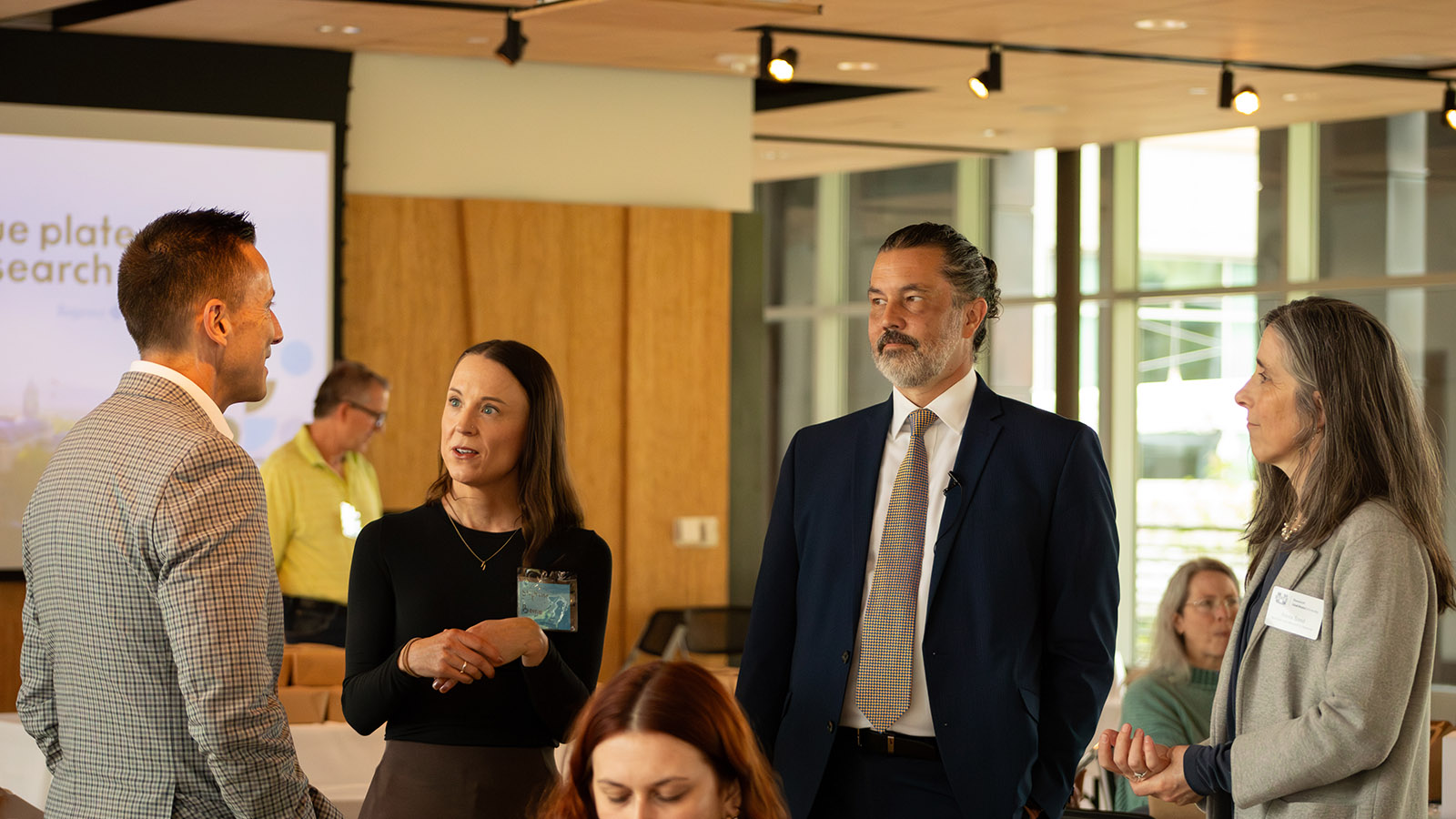
Pictured: USU President Brad Mortensen, CEHS Associate Dean for Research Stephanie Borrie, Matthew Wappett and USU Associate Vice President for Research Alexa Sand.